
The Hidden Cost of Playing It Safe: Over Specification in Liquid Filtration
Filtration over-specification often begins with good intention. When engineers add margin upon margin to a filter specification, they believe they are buying reliability. What they may be buying instead is waste, pressure drop, and failure. In industrial filtration, safety margins are often added across flow rates, pressure ratings, micron retention, and housing material grades. Individually, each decision may seem rational. Collectively, they can create a system that costs more to buy, more to operate, and paradoxically performs worse than one specified correctly from the start.
This case learning examines the anatomy of over specification in liquid filtration, the downstream consequences that rarely appear in initial cost comparison, and the discipline required to specify right not just safe.
What Does Over-Specification Look Like?
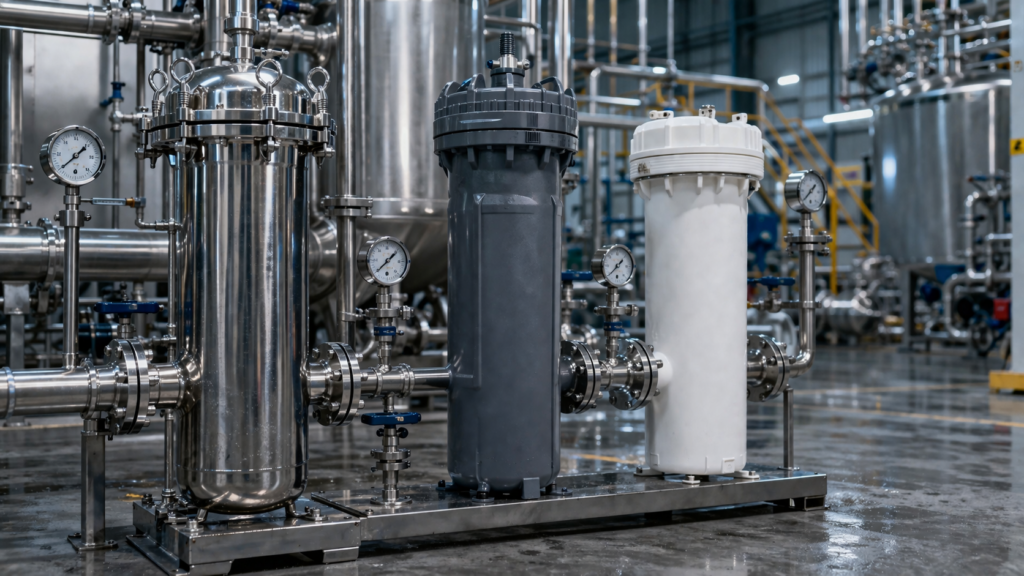
Over-specification does not announce itself. It arrives dressed as diligence. Common patterns include selecting a filter micron rating far finer than the process genuinely requires, choosing a housing material such as 316L stainless steel for a fluid that could be handled by polypropylene, sizing a housing for peak flow that rarely occurs, or specifying multi-stage filtration where a single stage would suffice. Each of these choices may appear conservative in isolation. The problem emerges when they are compounded, and when no one returns to the original process data to ask whether the specification still reflects reality.
The Real Consequences
The effects of over-specification extend well beyond initial capital expenditure. They touch operating cost, maintenance burden, product quality, and process reliability. Finer micron filters may blind faster, creating higher consumable spend over the equipment lifecycle. A filter sized far beyond actual duty may create poor flow behaviour and uneven loading. In fine chemical or semiconductor-related applications, an over-fine filter may even interfere with the process by removing particles that should remain in suspension.
Over-specification can also lock unnecessary capital into the wrong equipment. Oversized stainless housings for mild-duty service may look safer at purchase stage, but they become a costly benchmark for future projects. What looks like a conservative engineering decision can slowly become a recurring operating burden.
Case Snapshot: Chemical Blending Plant
In one chemical blending operation, a facility had standardised on 1-micron absolute rated cartridges across the plant. The specification had originally come from a single critical finishing step years earlier, then was copied into later installations for simplicity. Over time, the plant experienced filter changeout frequency three to four times higher than expected. Differential pressure alarms were triggered weekly, and maintenance teams initially blamed the fluid rather than the filter specification.
A process audit showed a different root cause. Many filtration points required only 25-micron nominal retention. The 1-micron filters were capturing fine pigment particles that the downstream process actually needed in suspension. The lesson was clear: each filtration point must be specified against its own process requirement, not inherited from the most stringent application in the plant.
Case Snapshot: Electronics Cooling Loop
In another case, a process cooling loop carrying deionised water was specified with 316L stainless steel filter housings. The selection was made because the facility processed aggressive chemicals elsewhere, and purchasing wanted to standardise the hardware. On paper, this looked efficient. In operation, it introduced a hidden issue.
Over time, trace ions from the stainless steel affected the high-purity water loop. Resistivity began to drift, triggering out-of-spec alarms in downstream conductivity monitoring. The housings were later replaced with electropolished PVDF, and the resistivity stabilised. The lesson was that material selection must account for fluid purity requirements as well as chemical compatibility. A “better” material grade can still be the wrong material for the process.
Specifying with Discipline
The antidote to over-specification is not under-specification. It is a structured return to process fundamentals. Every filter selection should begin with questions, not assumptions. What particle size actually causes process harm at this point? What is the real sustained flow rate, not the theoretical peak? What are the chemical compatibility requirements at operating temperature? What is the expected contamination load? Does the application require absolute rated retention, or is nominal retention sufficient?
When these questions are answered from data rather than convention, the specification often becomes simpler and more appropriate than the one inherited from habit. The most expensive filter is not always the finest one. It is the one that was never questioned.
At KETCO, our approach to filter selection begins with a process conversation, not a product catalogue. The right filter for the job is rarely the most expensive one. It is the one that performs predictably, at the lowest total cost, for the life of the process. If you are reviewing filtration specifications or suspect over-specification in your system, contact us at sales@filter.com.my for a free filtration audit.