

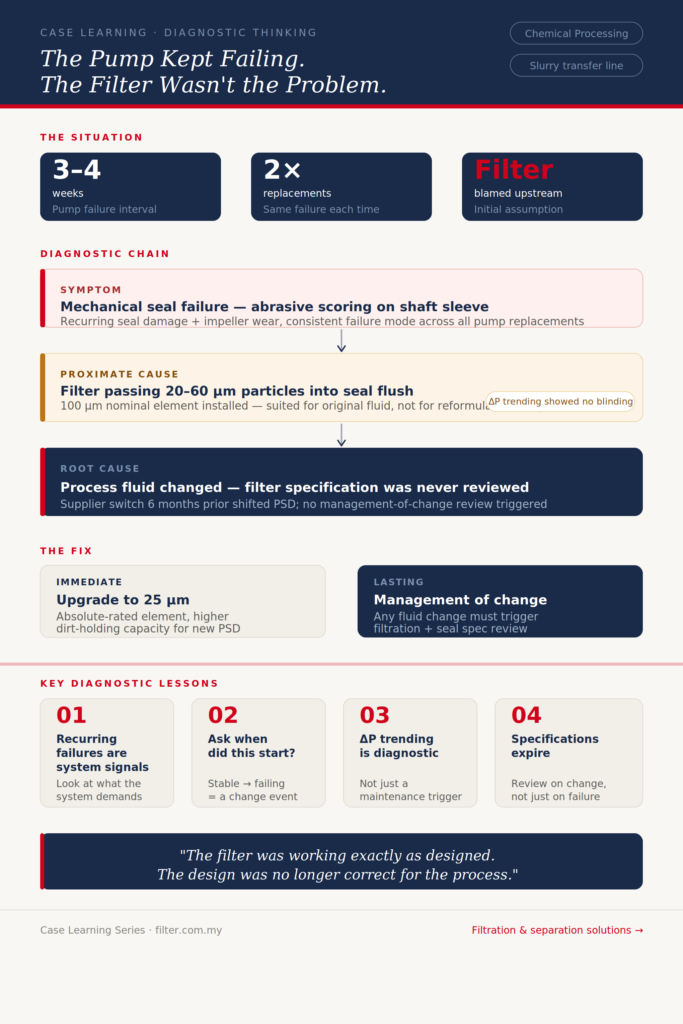
The Pump Kept Failing. The Filter Wasn’t the Problem.
Pump failure filtration issues often create the wrong first assumption. When a pump repeatedly fails, the filter becomes an easy suspect. In this case learning, a recurring equipment failure appeared to be a filtration problem — until the investigation shifted upstream and revealed a different root cause entirely.
Every site has that one problem that refuses to stay fixed. Technicians replace parts, supervisors become frustrated, and maintenance records quietly accumulate.
This was one of those cases.
A Pump That Wouldn’t Stop Failing
The client operated a mid-sized chemical blending facility. One slurry transfer line used a centrifugal pump that failed every three to four weeks. The failure pattern remained consistent. Mechanical seal damage appeared repeatedly, sometimes together with impeller wear. The pump would run normally for a period, then rapidly degrade and trip on overload or vibration.
The maintenance team replaced the pump twice. During the second replacement, they upgraded to a more robust model. The same failure pattern continued. Since an inline filter sat directly upstream of the pump, the team suspected the filter was either partially blocking flow or allowing particles to pass downstream. KETCO was asked to evaluate the filtration setup.
The initial assumption seemed straightforward: the filter was blinding between maintenance cycles, starving the pump and causing cavitation-related wear. The expected solution was to replace or upgrade the filter element.
What the Investigation Revealed
The first step was not to inspect the filter. The first step was to map the system. Pump failures are often symptoms rather than root causes. The more useful question is not “what failed?” but “what operating condition caused the failure?”
KETCO reviewed maintenance logs, pump curves, filter change-out records, and process conditions over the previous six months. Several findings stood out immediately.
Filter differential pressure remained low at the time of failure. If the filter had been blinding, a rising differential pressure trend would have appeared before each event. That trend did not exist. In fact, the filter was often changed while it still had remaining service capacity.
The failure mode also remained consistent. The mechanical seals showed abrasive scoring on the shaft sleeve. This pointed toward particulate ingress into the seal chamber rather than cavitation from flow starvation.
The investigation then uncovered a process change. About six months earlier — matching the beginning of the failures the client had switched suppliers for one blend component. The slurry particle size distribution had changed.
At the same time, the installed filter element remained unchanged. The system still used a 100 micron nominal-rated filter selected years earlier for the original process fluid. Nobody had reviewed the filtration specification after the process fluid changed.
The Real Root Cause
The filter was operating exactly as specified. The specification itself was no longer correct for the process.
The new slurry contained a higher concentration of particles in the 20–60 micron range. The 100 micron nominal filter allowed most of those particles to pass through. These particles entered the flush fluid and migrated into the mechanical seal faces, creating the abrasive wear pattern observed during inspection.
The pump was not the true failure point. The filter was not malfunctioning. The process had changed quietly, but the protection strategy stayed the same.
The immediate correction involved upgrading the filtration stage to an absolute-rated 25 micron element with higher dirt-holding capacity. KETCO also recommended reviewing the seal flush arrangement to introduce a secondary protection barrier.
The longer-term lesson was procedural. Any change in process fluid specification should trigger a review of filtration and protection systems across that process line. Filtration specifications should evolve together with the process they protect.
What This Case Teaches
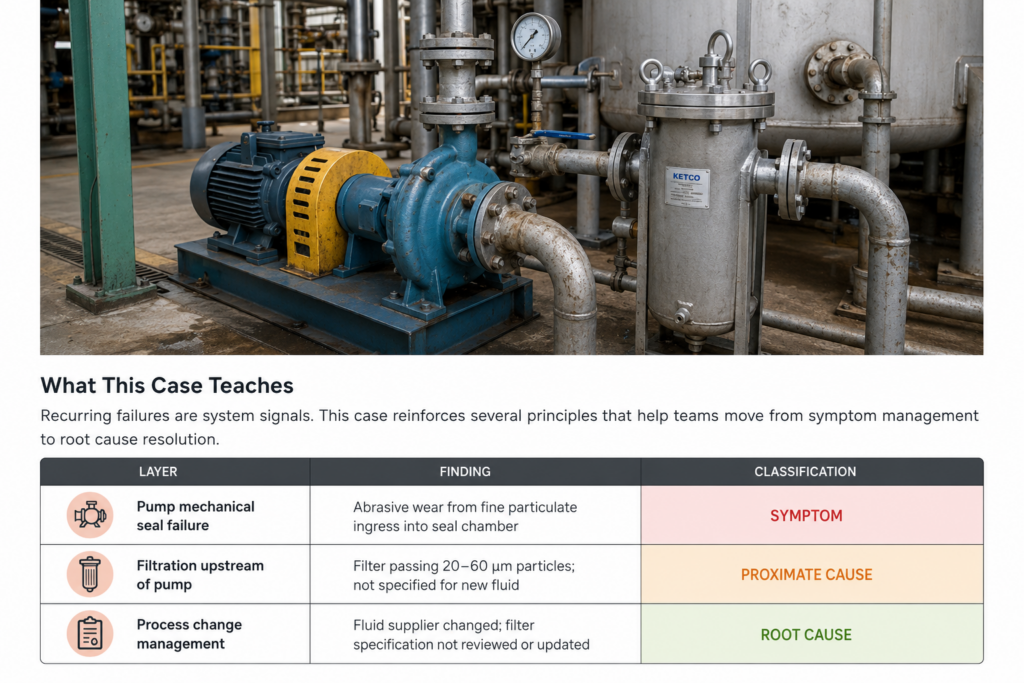
Recurring failures are system signals. When the same component continues to fail, the component itself is often not the root cause. The more important question is what condition the system is repeatedly imposing on it.
This case also reinforces another important principle: specifications expire. A filter specification written for one process condition may become unsuitable after a process reformulation, supplier change, or operating adjustment. Reviewing filtration performance only after failure is often too late.
Differential pressure trending, vibration analysis, and seal failure inspection all pointed toward the same story once the data was reviewed together. The solution did not begin with replacing equipment again. It began with understanding what had changed in the process.
If your system is experiencing recurring equipment failure linked to process filtration, KETCO can help review filtration specifications, process changes, and protection strategy alignment. Contact us at sales@filter.com.my for a free filtration audit.

