
In the high-stakes world of industrial production, a sudden halt due to “filter failure” usually triggers a predictable reaction: swap the element and get the line moving. However, technical audits often tell a different story. Frequently, the filter didn’t fail mechanically it performed exactly as engineered. The real breakdown occurred because the operational environment shifted away from the original design assumptions. This phenomenon is known as Operational Drift, and it is the hidden driver behind skyrocketing maintenance costs and unexpected downtime.
Most filtration systems are specified based on a “steady state” snapshot taken during a plant’s initial design. Engineers calculate flow rates, viscosity, and contaminant loads based on ideal conditions. But the plant floor is dynamic, not static. When we treat initial parameters as permanent constants, we create a dangerous gap between the filter’s limits and the plant’s reality. To protect your uptime, the focus must shift from the hardware to the shifting variables that undermine it.
The Conflict Between Static Design and Dynamic Reality
Filtration failure is rarely an isolated event it is usually the result of silent shifts in your production baseline. For example, a system designed for a 16 hour duty cycle that is suddenly pushed to 22 hours doesn’t just face “more” contamination it faces entirely different thermal and pressure profiles. Similarly, subtle changes in raw material suppliers can introduce new particulate shapes or trace chemical elements that your media was never tested against. These factors push your fluid chemistry outside the filter’s optimal performance zone, causing issues that are frequently misdiagnosed as hardware defects.

These operational shifts often masquerade as mechanical failures in maintenance reports. Consider a common thermal shift: metalworking fluid designed for 40°C might spike to 65°C due to new, high-speed machinery. This drop in viscosity significantly reduces filtration efficiency. In other cases, “process creep” minor adjustments made by operators to boost performance can cause chemical concentrations to shift, leading to filter fiber swelling. This increases the pressure drop (Δ P) and triggers a “blockage” alarm even when the filter is relatively clean. None of this is a “filter failure” it is a conceptual mismatch.
Engineering for Resilience, Not Just Replacement
Correcting a conceptual mismatch with more frequent filter changes is a cycle of diminishing returns. True reliability requires moving toward a strategy that accounts for variability. This begins with continuous monitoring. Relying on a calendar for maintenance assumes that conditions never change. By utilizing real-time differential pressure sensors and particle counters, you can make decisions based on the actual health of the fluid rather than an arbitrary date. In this framework, a prematurely saturating filter isn’t a nuisance it’s a critical diagnostic signal.
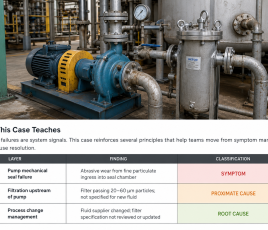
The ultimate goal is to manage the health of the entire fluid circuit by enforcing upstream accountability. If a filter is loading too quickly, look beyond the housing. Check for accelerated wear in pumps, failing seals, or improper makeup fluid practices. A filter is a boundary, not a promise. When we recognize that process drift is inevitable, we can stop treating the symptoms of “failure” and start engineering for operational reality. Next time a filter triggers an alarm, don’t ask what’s wrong with the hardware; ask what changed in the process that the hardware wasn’t designed to handle.
Stop Treating Symptoms. Start Solving Problems.
Are you seeing unexplained downtime? Contact our technical team Or Linked In today for a free filtration system assessment. We look beyond the filter to identify the real drivers behind your maintenance costs.