
When a filtration system underperforms, the cartridge is almost always the first thing that gets blamed. A new brand is ordered. A different micron rating is tried. The change frequency is adjusted. And yet the problem persists.
In most cases we investigate, the cartridge is not the issue. The housing is.Filter housings are treated as background hardware — a steel or plastic vessel that holds the real component. They are selected once, installed, and largely forgotten. But the housing is where most filtration failures actually begin. And getting the selection wrong is far more costly than most plant managers realised.
The failure nobody sees coming
We visited a plant where filter cartridges were failing every three weeks. The maintenance team had already switched cartridge brands twice, adjusted the micron rating, and shortened the change interval. Samples had been sent to the cartridge supplier for analysis. Nothing explained the persistent downstream contamination.
When we examined the housing, the cause became clear within the first hour.
The bypass seal had degraded. It was not visibly cracked or broken — just worn enough to open a low-resistance path between the inlet and outlet sides of the housing. Fluid was bypassing the cartridge entirely, taking the path of least resistance around the filter media rather than through it.
What made this failure particularly difficult to identify was the pressure reading. The differential pressure across the housing was lower than expected. The team had interpreted this as a positive sign — low dP suggesting no blockage, the system appearing to run freely.
It was the opposite of a positive sign. Low dP in this context meant the fluid had stopped being forced through the resistance of the filter media altogether. The bypass path had effectively removed the cartridge from the flow circuit. The system was not blocking — it was not filtering.
Three months of troubleshooting. Repeated cartridge replacements. Every intervention directed at a component that was not the source of the problem. The bypass seal — which cost a fraction of a single cartridge replacement — had been the root cause from the beginning.
This failure mode is deceptive precisely because its operational signals look benign. Pressure reads normal or low. Flow rate is maintained. The only indication that something is wrong is contamination that should not be present downstream. In plants where downstream quality checks are infrequent or where the contamination is subtle, this failure can persist undetected for months.
The five specs most teams get wrong
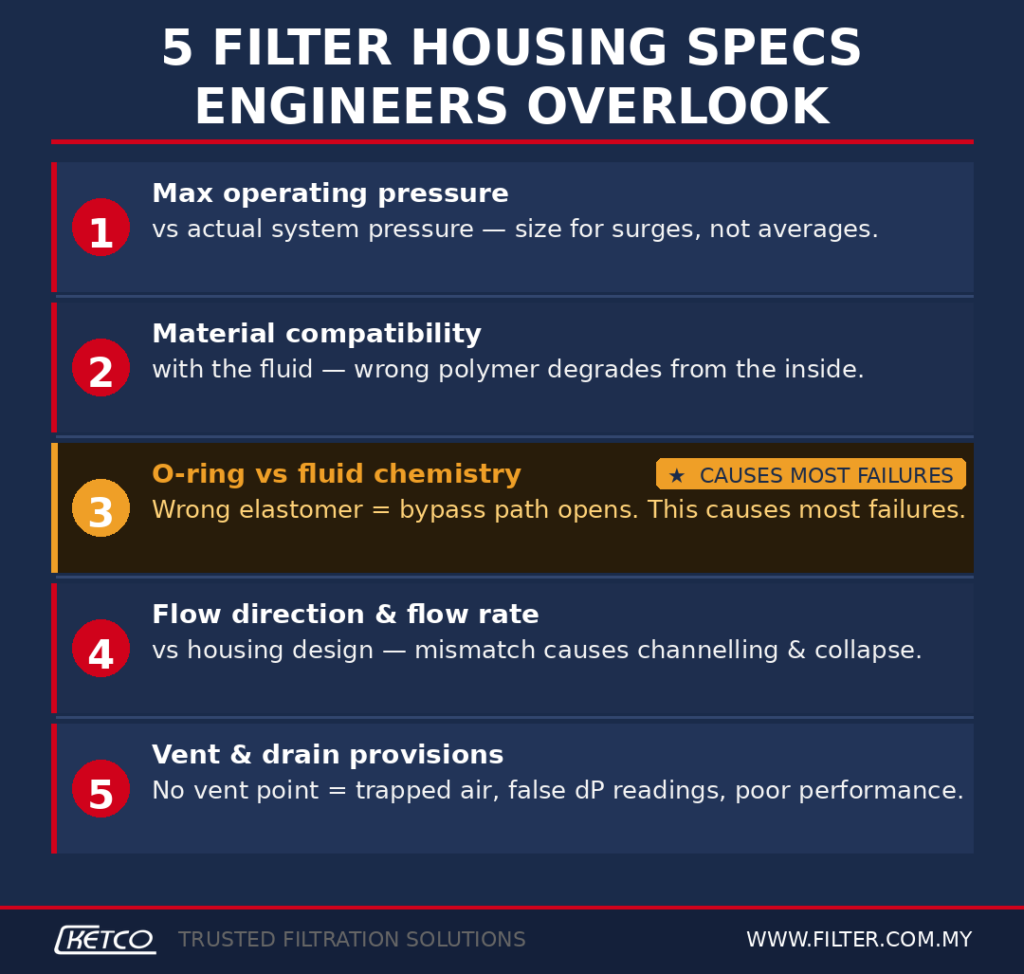
Housing selection errors almost always fall into one of five categories.
Maximum operating pressure versus actual system pressure.
A housing rated for your normal operating pressure may not handle the surge events, pump start-up transients, or line clearing pressures your system regularly experiences. Even brief spikes above rated pressure can permanently deform a housing body or end-cap, creating leak paths that are invisible until a failure event occurs.
Material compatibility with the process fluid.
Polypropylene is a cost-effective choice for many applications. Expose it to certain solvents, elevated temperatures, or aggressive chemistries and it degrades from the inside out. The housing continues to look intact while its structural integrity deteriorates.
O-ring material versus fluid chemistry.
This single specification causes more failures than any other. An EPDM elastomer in a hydrocarbon service will swell and lose its sealing function. A Buna-N o-ring in an oxidising environment will harden and crack. The bypass path that opens is not always visible, but the contamination it allows through is real. Fluid chemistry must determine elastomer selection — not cost, not availability, and not historical precedent.
Flow direction and flow rate versus housing design.
Single open-end and double open-end housings are not interchangeable. In-to-out and out-to-in flow configurations load the cartridge media differently. Mismatching the housing design to the flow requirement creates channelling, uneven media loading, and premature cartridge collapse — symptoms that look identical to an undersized or inferior cartridge.
Vent and drain provisions.
In liquid filtration, trapped air causes flow restriction and generates false differential pressure readings. A housing without adequate vent and drain provisions cannot be properly commissioned or maintained, leading to chronic performance issues that are difficult to diagnose.
The two questions that prevent most failures
Before recommending any housing, we ask two questions that the selection process rarely surfaces on its own.
The first: what is the worst-case condition this housing will see — not the normal operating condition? Process temperature peaks, pressure surge events, fluid composition changes during cleaning or product changeover — the housing must be designed for the extremes, not calibrated for the average.
The second: what does failure look like in this application, and what is the cost of that failure? A housing bypass event in a non-critical utility application is a maintenance issue. The same event in a pharmaceutical process, a food production line, or a high-value batch manufacturing environment is a production loss, a compliance event, or a safety incident. The consequence of failure should directly determine the specification criteria.
These two questions take five minutes to answer. They have, on multiple occasions, changed the housing specification entirely — and prevented failures that would have cost our clients significantly more than the hardware.